AI in Hospitality Speaker
Artificial Intelligence and Hospitality: How the Hospitality Industry Can Benefit from Technology!
Forbes Travel Guide says Chris is one of the “Thought leaders elevating service, innovation, and human experience.”
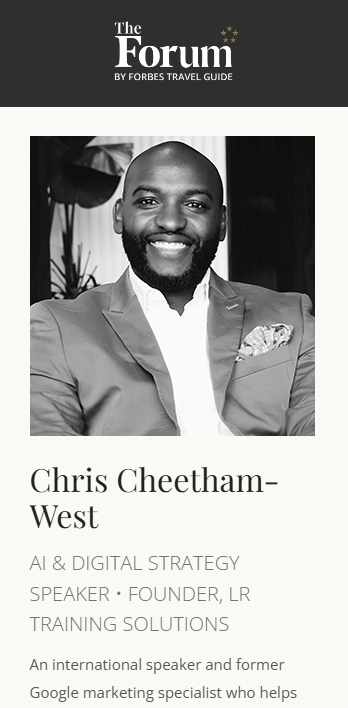
Chris is a AI in Hospitality Expert That Gets Results!
Brands across the U.S.A. Europe, Canada, and more reach out to Chris and his team about delivering impactful presentations and insights tailored to their teams and events.
Title and Description of Hospitality Topic:
AI in the Hospitality Industry: How AI Can Drive Positive Growth
There are so many ways AI can help your organization, and you may be stuck trying to determine which way is best for you. In this AI in the hospitality industry presentation, we cover several new ideas on artificial intelligence that many in the hospitality field can use to get results. It is very easy to get overwhelmed by how fast AI is moving. There are a number of online tools that are now readily available. We will make sure you are up to date and stay ahead in this new, ever-changing landscape.
AI in the Hospitality Session Objectives:
-
Learn about top tools such as ChatGPT, Google’s Gemini, and other AI platforms
-
Discover how AI tools can enhance productivity
-
See examples of artificial intelligence in the hospitality industry

Understand what AI means for the hospitality industry
AI in Hospitality Speaker Options
Speaking Type Available
-
Seminar
-
Workshop
-
Keynote
Experience: 10 Years of Speaking Experience | 48 US States
Contact to work with Chris as an AI in Hospitality Speaker or Trainer for Your Team
Custom topics around AI are also available
AI in Hospitality Blog
AI in Hospitality: How Artificial Intelligence Transforms Hotels and Guest Experience
AI in Hospitality Speaker Topics
AI technology is moving at a fast pace. Teams and organizations can use artificial intelligence to grow their operations to new levels.
AI technology is advancing at an unprecedented pace, offering transformative opportunities for teams and organizations. By leveraging artificial intelligence, busi
nesses can optimize operations, enhance guest experiences, and unlock new levels of growth and innovation.
AI-driven tools empower teams to analyze vast amounts of data, uncover insights, and make informed decisions faster and with greater precision. For instance, predictive analytics can help

AMA Houston Marketing Edge Conference held Thursday November 9, 2023 at the Bell Tower in Houston, TX.
Nathan Lindstrom Photography
anticipate travel and booking trends, while machine learning models can streamline repetitive tasks, freeing up valuable time for employees to focus on service and strategy.
Hospitality speaker topics can also be customized.
This program is built for hospitality teams and leaders across hotels, resorts, venues, restaurants, tourism organizations, and service-based brands—especially front desk teams, guest services, operations, HR, sales, and management, luxury hospitality events
Additionally, AI can revolutionize customer engagement in hospitality by personalizing interactions, providing instant support through chatbots, and tailoring marketing campaigns to individual preferences. Organizations adopting AI also gain a competitive edge by automating workflows, improving efficiency, and scaling their operations more effectively. As a keynote speaker for hospitality industry, Chris has this in mind!
As an expert on AI in the hospitality industry, Chris focuses on results. He has been a speaker in the following states:
Alabama, Alaska, Arizona, Arkansas, California, Colorado, Connecticut, Delaware, Florida, Georgia, Hawaii, Illinois, Indiana, Iowa, Kansas, Kentucky, Louisiana, Maine, Maryland, Massachusetts, Michigan, Minnesota, Mississippi, Missouri, Montana, Nebraska, Nevada, New Hampshire, New Jersey, New Mexico, New York, North Carolina, North Dakota, Ohio, Oklahoma, Oregon, Pennsylvania, Rhode Island, South Carolina, South Dakota, Tennessee, Texas, Utah, Vermont, Virginia, Washington, West Virginia, Wisconsin.
Chris has just two more states until he gets to 50! He makes himself the best choice as a motivational keynote speaker by researching and understanding his clients’ businesses. Chris is a speaker focused on AI in the hospitality industry and how technology can make a positive impact on organizations. Stop the speaker near me searches! Chris is here to help!
The Future of AI in Hospitality
In the next three to five years, artificial intelligence will completely redefine how the hospitality industry operates and connects with guests. Hotels, restaurants, and travel brands will use AI not just to streamline operations, but to anticipate guest needs before they even arrive. Predictive systems will analyze booking history, travel patterns, and even social media activity to create hyper-personalized experiences—from preferred room temperatures to customized dining recommendations. Front desks will become smarter, using voice and facial recognition to offer seamless check-ins, while AI-powered concierge systems will provide curated suggestions in real time.
Behind the scenes, AI will help hospitality leaders make faster, smarter decisions. Advanced analytics will give insight into occupancy trends, seasonal demand, and customer sentiment, allowing management teams to adjust pricing, staffing, and marketing in real time. Automation will also play a larger role in operations—from inventory management to housekeeping scheduling—reducing costs and improving accuracy. The result will be a leaner, more responsive organization that can quickly adapt to changes in guest behavior and global travel trends.
AI will also be a driving force for sustainability and guest trust in the hospitality sector. Smart energy systems powered by machine learning will reduce waste by adjusting lighting, heating, and cooling based on occupancy and usage patterns. Meanwhile, AI-driven feedback systems will help brands respond instantly to guest concerns, ensuring consistent quality and reputation management. The future of hospitality will be defined by a perfect blend of technology and human touch—where artificial intelligence empowers employees to deliver authentic, memorable, and efficient experiences that keep guests coming back.
AI and the Evolving Hospitality Workforce
As AI becomes more integrated into hospitality operations, the role of employees will shift from transactional tasks to relationship-driven service. Automation will handle repetitive responsibilities such as check-ins, payment processing, and standard guest requests, allowing staff to focus on empathy, problem-solving, and creating memorable moments. Training programs will also incorporate AI, helping hotels and restaurants assess employee performance, identify skill gaps, and deliver personalized learning experiences. Far from replacing jobs, AI will elevate frontline teams by giving them more time and insights to provide exceptional service.
AI-Enhanced Revenue Management
Revenue managers will rely heavily on AI-powered forecasting tools that consider thousands of variables—from competitor pricing to event calendars and even weather patterns. These tools will dynamically update pricing across rooms, amenities, and food & beverage offerings, maximizing revenue in real time. As prediction accuracy improves, hotels will be able to anticipate demand weeks or months in advance, allowing for smarter budget planning and more strategic marketing campaigns. Ultimately, AI will transform revenue management into a proactive, data-led discipline.
Marketing Personalization and Guest Acquisition
AI will completely reshape hospitality marketing. Instead of broad campaigns, hotels will use generative AI to create personalized content for specific guest segments—business travelers, families, luxury clients, or international tourists. Machine learning models will identify high-value guests and automatically tailor messaging, offers, and packages that appeal directly to their preferences. Chatbots and virtual assistants will also manage early-stage engagement, answering questions instantly and guiding potential guests through the booking process. This level of personalization will drastically increase conversion rates while reducing marketing costs.
AI for Safety, Security, and Risk Management
The future of hospitality will also include AI-driven safety and risk prevention tools. Computer vision can analyze video feeds to detect unusual behavior, overcrowding, or potential hazards in real time. Smart sensors in rooms and public areas can alert staff to water leaks, air quality issues, or equipment problems before they escalate. Predictive AI models will help hotels anticipate maintenance needs, reducing downtime and extending the lifespan of expensive assets. These innovations will not only increase guest safety but also lower operational risks for hospitality brands.
AI-Driven Food & Beverage Innovation
Restaurants and hotel kitchens will benefit from AI tools that optimize menu planning, reduce food waste, and improve guest satisfaction. Systems will analyze guest preferences, dietary patterns, and purchase history to recommend menu items that are likely to perform well. Smart inventory tools will track ingredient usage and predict needed quantities to prevent shortages or spoilage. Even kitchen operations will become more efficient, with AI-powered scheduling and equipment monitoring ensuring consistent food quality and faster service.
FAQ
What does an AI in hospitality speaker cover?
An AI in hospitality speaker explains how artificial intelligence is being used across hotels, resorts, restaurants and tourism operations — from revenue management and occupancy forecasting to guest personalisation, front desk operations and marketing. Sessions focus on what is working now, what is still hype, and which decisions a leadership team should make this year.
Who is this session designed for?
Hospitality teams and leaders across hotels, resorts, venues, restaurants, tourism organisations and service brands — particularly front desk and guest services, operations, revenue management, HR, sales and general management. Both technical and non-technical audiences are catered for.
Will AI replace hospitality staff?
What AI tools does the session cover?
Can the session be customized for our property or association?
How much does it cost to book an AI in hospitality speaker?
AI in Hospitality Speaker Bio
Chris Cheetham-West, MBA, is an AI in the hospitality industry speaker, author, and Founder of LR Training Solutions. Global brands, Fortune 500 companies, and government agencies seek out Chris and his company for their events and training. In his former position at Google, he managed marketing programs and strategies for key products. Experienced and driven, Chris’s career has allowed him to present in 48 states and to teams in various countries, including Serbia, Germany, Canada, and France. He has spoken to numerous organizations in the travel and tourism industry.
Chris has worked with teams at global brands such as The Government of Canada, Lamar Advertising, Pattern Beauty by Tracee Ellis Ross, and more. He is the author of multiple books, including Leading in a Virtual World: Lead Remote Teams, Boost Productivity, and Master Virtual Collaboration. Chris is sure to put clients first when it comes to speaking a

nd training teams. He is also an AI consultant who helps teams understand technology. Bring him in as a speaker for your conference or retreat today!